
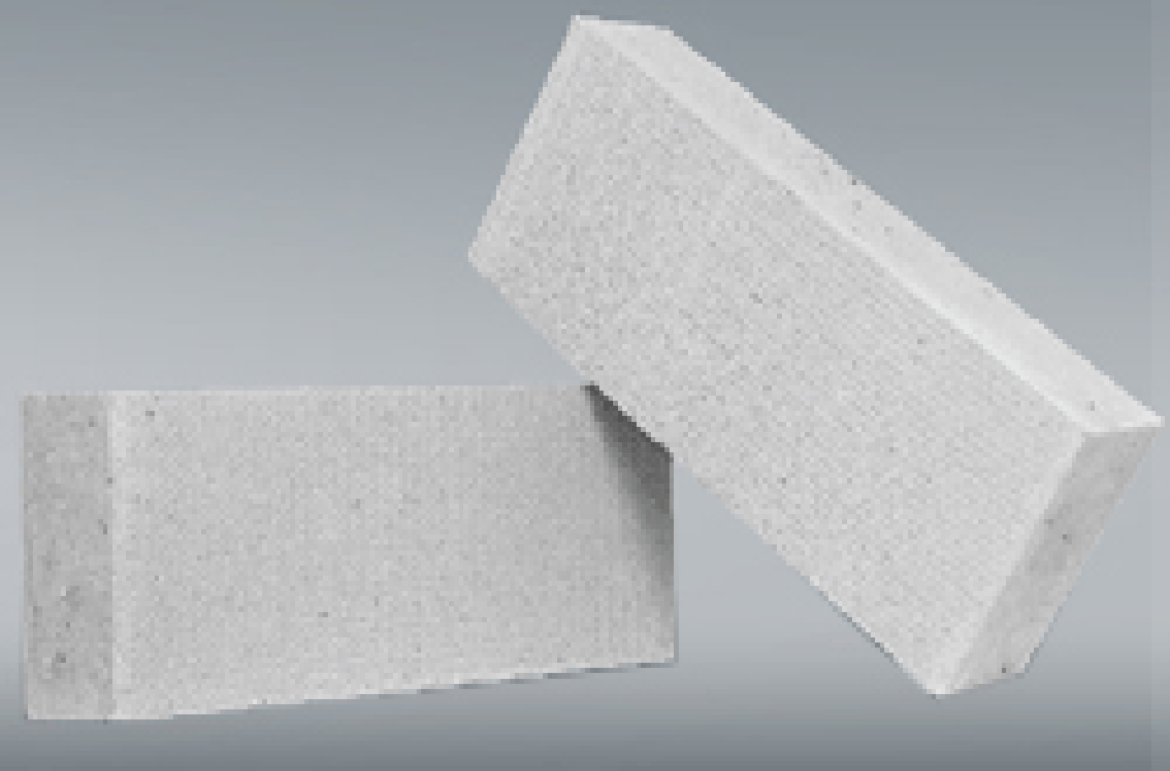
In India production of AAC block started in 1972. AAC Blocks is a unique and excellent type of building materials due to its superb heat, fire and sound resistance General People Understand about AAC From 2013 before that AAC was invented in the mid-1920’s by the Swedish architect and inventor Johan Axel Eriksson. After Long Period AAC Takes Pickup, Now AAC is Very Popular Construction Product in India. Also AAC is one of the major achievements of the 20th century in the field of construction. It is a lightweight, precast building material that simultaneously provides structure, insulation, and fire and mold resistance. AAC block is lightweight and offers ultimate workability, flexibility and durability.
Main Raw Materials include Fly ash, water, quicklime Powder, OPC cement, aluminum powder or Aluminum Past and gypsum also Many types of Aggregate and Bounding Additive we can use in AAC. The block hardness is being achieved by cement strength as well as Curing Systems and instant curing mechanism by autoclaving. Gypsum acts as a long term strength gainer. The chemical reaction due to the aluminum paste provides AAC its distinct porous structure, lightness, and insulation properties, completely different compared to other lightweight concrete materials. The finished product is a 4 times lighter Block compared to Other Concrete Bricks, while providing the similar strengths.
The Density stays around 600 kg/m3 to 700 kg/m3, because using these blocks in structural buildings, the builder saves around 30 to 35 % of structural steel, and concrete, as these blocks reduce the dead load on the building significantly.
AAC is a long proven material. AAC block is used in a wide range of commercial, industrial and residential application and has been in use in EUROPE over 90 years, playing significant role in UK, Middle East, America and Australia construction industry now a days in Maharashtra, Telangana, Andra Pradesh, Gujarat, and MP Is Using Large Amount Of AAC Blocks in There Construction. This unit is proposed to manufacture AAC Blocks by consuming the Fly-Ash or Any Silica Present Aggregate as one of the prime raw material. Fly-Ash, a major raw material with 70% proportion in AAC Blocks, an indispensable by-product of Thermal Power Plants, is an environmental threat across the globe. Power plants are facing an ever increasing challenge of disposal of this polluting agent.
Advantages AAC BLOCK
Fire Resistant
Depending upon the thickness of the Autoclaved Aerated Concrete (AAC) Blocks, they offer fire resistance from 2 hours up to 6 hours. These blocks are highly suitable for the areas where fire safety is of great priority.
Pest Resistant
Autoclaved Aerated Concrete (AAC) Block consist of the inorganic material in its constitution that helps preventing/avoiding termites, damages or losses.
Sound Proof
The porous structure of the AAC blocks results into enhanced sound absorption. The Sound Transmission Class (STC) rating of the AAC blocks up to 45 db. Thus, AAC blocks have been the most ideal material for the construction of walls in auditorium, hotels, hospitals, studios, etc.
Earthquake Resistant
The light weight property of the AAC blocks results into higher steadiness of the AAC blocks in the structure of the buildings. As the impact of the earthquake is directly proportional to the weight of the building, the building constructed using AAC blocks are more reliable and safer.
Faster Construction
As the AAC block is very easy to handle, manipulate and use ordinary tools for cutting the wood such as the drill, band saws, etc. could be easily used to cut and align the AAC. Moreover, the AAC blocks come with larger sizes and fewer joints. This ultimately results in faster construction work as the installation time is significantly reduced due to fewer amounts of blocks and the masonry amount involved is also lowered resulting into reduced time-to-finish.
Long Lasting
AAC blocks are highly superior in terms of the strength. Higher level of strength of these blocks gives higher stability to the structure of the building. AAC is manufactured from non-biodegradable materials, which neither rot nor attract mould, keeping interiors clean and durable.
Comparison of AAC Block, Clay Brick, CLC Brick
| S.No | Parameter | AAC Blocks | Red Clay Bricks | CLC Blocks |
| 1 | Raw Materials | Cement, fly ash, water and Air entraining agents | Locally avaiable clay | Cement, lime, specially grinded sand, foam |
| 2 | Size | 400-600mm X 200mm X 150mm – 300mm | 225mm X 75mm X 100/150mm | 400-600 x 200 x 100/150/200 mm |
| 3 | Variation Size | 1.5 mm (+/-) | 5 mm (+/-) | 5 mm (+/-) |
| 4 | Compressive Strength (As per IS codes) | 3-4 N/mm2 | 3.5 N/mm2 | 2 -2.5 kg/cm2 |
| 5 | Dry Density (As per IS codes) | 550-650 kg/m3 Its one-third of the weight of clay brick which makes it easy to lift and transport | 1800 kg/m3 | 800 kg/m3 |
| 6 | Cost Benefit | For high rise buildings there will be reduction of Dead weight which leads to saving in Concrete and steel quantities. | As easily available in local market hence it is beneficiary for low rise structure. | For high rise buildings there will be reduction of Dead weight which leads to saving in Concrete and steel quantities. |
| 7 | Fire Resistance (8″ Wall) | Upto 4 Hours | Around 2 Hours | Upto 4 Hours |
| 8 | Quality of End Product | Factory made product. So the quality of end product is consistent and good | Locally made product. Quality depends on various parameters like quality of raw materials used, process of manufacture etc., | The quality of the end product depends on the foam used and degree of quality control |
| 9 | Sound Insulation | Better Sound absoprtion/insulation as compared to bricks | Normal | Better Sound absoprtion/insulation as compared to bricks |
| 10 | Energy Saving | Low thermal conductivity (0.24 Kw-M/C) helps in saving electricity costs 30% for heating and cooling of house | High thermal Conductivity (0.81 Kw-M/C). So no significant cost savings | Low thermal conductivity (0.32 Kw-M/C) helps in saving electricity costs 30% for heating and cooling of house |
| 11 | Environmental Friendliness | In AAC Block there is no top soil consumption and it emits very low Carbon dioxide as compare to Red clay bricks while manufacturing | One sq ft of carpet area with clay brick walling will consume 25.5 kg of top soil (approx). It actually damages environment | In CLC Block there is no top soil consumption and it emits very low Carbon dioxide as compare to Red clay bricks while manufacturing. |
| 12 | Internal and External Plaster | As these bricks have dimensional accuracy, the internal and extenal plaster thickness can be reduced | Requires thick plaster surface as there are variations in the dimensions | As these bricks have dimensional accuracy, the internal and external plaster thickness can be reduced |
| 13 | Finishing | excellent | Very bad | Not linear |
| 14 | Joining Process | Chemical mortars can be used for joining the brick. This reduces the material consumption of cement and also avoids curing process | Traditional mortar needs to be used and the brick work should be cured atleast for 7 days before plastering | Chemical mortars can be used for joining the brick. This reduces the material consumption of cement and also avoids curing process. |
| 15 | Availability | Factory setup cost is high.Not many factories, so availability is a concern. | Available locally in all cities and villages. | Factory setup cost is low as compared to AAC. Also takes long time to produce if steam curing is not used.Timely availability is a concern. |
| 16 | Thermal Insulator | AAC Blocks are very good thermal insulator if cooling is an major component of any building monthly expenses it will save cost for entire lifetime | It have low thermal insulation as compare to AAC and CLC Block | CLC Blocks are very good thermal insulator if cooling is an major component of any building monthly expenses it will save cost for entire lifetime |
| 17 | Tax Contribution | GST REFUNDABLE | No Tax Contribution | GST REFUNDABLE |
| 18 | Cylindrical Structures | For Cylindrical structure these blocks are not much useful | Cylindrical manholes or sewage chambers need small size of bricks so that the curvature can be formed hence Red clay bricks are useful | For Cylindrical structure these blocks are not much useful |
| 19 | Water Absorption | Absorb 12- 15% by total volume of AAC blocks | Absorb 17 -20% by total volume of red clay brick | Absorb 12-15% of water by total volume of Block |
| 20 | Range of Application | They are suitable for Non load bearing or RCC structure in partition wall | They are useful in both load bearing and non load bearing structure | They are suitable for Non load bearing or RCC structure in partition wall |
Want to know the Setup Cost & Process OF AAC block Manufacturing Call Us We’ll help.
 Ankush Sharma Blog